


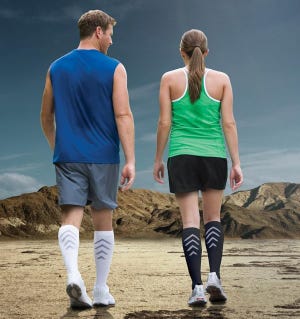

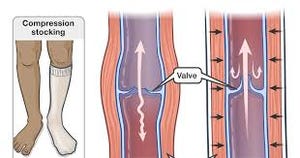
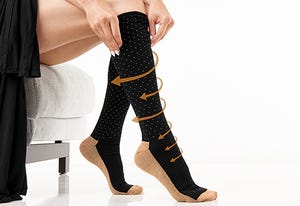
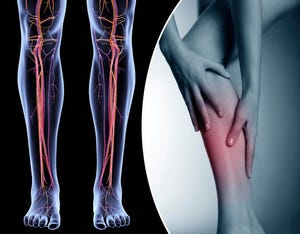




Compression socks for flying are the cheapest piece of travel gear that does something measurable to your body, and the research behind them is stronger than most people expect. They work by squeezing your ankle harder than your calf, which nudges blood back up toward your heart while you sit still. That squeeze is why flight socks cut down on puffy ankles, tired legs, and the small but real risk of a clot on a long trip. This guide covers what pressure to buy, how to size them, when to put them on, and who should not wear them at all. Discount Surgical Stockings has been fitting travelers in medical-grade compression from Jobst, Sigvaris, Juzo, medi, and Therafirm for decades, so everything below reflects what actually works on a real travel day.
The short answer
- Most travelers: 15–20 mmHg graduated knee-high socks on any flight over four hours.
- Higher risk travelers: 20–30 mmHg, after a conversation with your doctor.
- Put them on at home before you leave, not on the plane.
- Fit matters more than pressure. Measure your ankle and calf in the morning.
- Skip them if you have peripheral artery disease or an open leg wound until a clinician clears you.
What do compression socks actually do on a plane?
They push fluid and blood out of your lower legs while your calf muscles are off duty. When you walk, your calf works like a pump that pushes blood upward against gravity. Sitting in a seat for six hours shuts that pump off, so blood and fluid pool below the knee.
Three things stack up in a cabin to make that worse:
- Cabin air is pressurized to the equivalent of roughly 6,000 to 8,000 feet of altitude, per CDC Yellow Book guidance.
- Cabin humidity often sits in the single digits, which pulls water out of you fast.
- Seat edges press on the back of your thighs and slow return flow even more.

Do compression socks prevent blood clots on long flights?
They dramatically lower the odds of a symptomless clot, and the evidence for that is high quality. A Cochrane review of 12 randomized trials covering 2,918 passengers found that of 2,637 people with follow-up data, 50 developed a symptomless deep vein thrombosis. Only three of them had worn stockings. Forty-seven had not.
Translated into numbers you can picture:
- Low and medium risk passengers: about 10 clots per 1,000 flyers without socks, down to about 1 per 1,000 with them.
- Higher risk passengers: about 30 per 1,000 down to about 3 per 1,000, according to the NIHR summary of the same data.
- The trials also showed less leg swelling and fewer surface-vein clots.
Here is the honest limit of that evidence. No one in those trials died, had a pulmonary embolism, or developed a clot with symptoms, so the review could not measure whether socks change those outcomes. The baseline risk is small to begin with: WHO's WRIGHT project put the absolute risk of venous thromboembolism at roughly 1 in 6,000 for a trip over four hours, though that risk roughly doubles compared with staying home. The American Society of Hematology reports a similar figure and reserves its strongest recommendation for travelers who already carry clot risk.
So the fair framing is this: DVT prevention while traveling is one benefit, and comfort is the benefit you will actually notice. Both come from the same pair of socks.
What compression level should you choose for a flight?
Most healthy travelers want 15–20 mmHg. That range gives real circulatory support, needs no prescription, and stays comfortable for a full travel day. Compression is measured in millimeters of mercury, the same unit used for blood pressure, and higher is not better.
| Level | Feels like | Best for | Prescription? |
|---|---|---|---|
| 8–15 mmHg | A snug athletic sock | Short hops under 4 hours, first-time wearers, mild end-of-day puffiness | No |
| 15–20 mmHg | Firm but easy to forget you have it on | The default for compression socks for long flights, ages 20 to 70, most economy travelers | No |
| 20–30 mmHg | Noticeably tight for the first hour | History of DVT, varicose veins, chronic venous insufficiency, flights over 8 hours, post-surgical travel | Recommended to ask your doctor |
| 30–40 mmHg | Difficult to don without a donning aid | Diagnosed lymphedema or severe venous disease, prescribed and fitted | Yes |

How long does a flight have to be for socks to matter?
Four hours is the threshold that shows up in nearly every guideline. The CDC uses four hours as its cutoff for travel-related clot risk and notes that more than 300 million people take long-distance flights each year, with risk climbing the longer you stay still.
| Flight time | Suggested approach |
|---|---|
| Under 2 hours | Optional. Useful if your legs swell on the ground anyway. |
| 2 to 4 hours | 8–15 or 15–20 mmHg for comfort. Worth it if you have a window seat. |
| 4 to 8 hours | 15–20 mmHg knee-highs. This is the sweet spot for compression socks for airplanes. |
| 8 hours and up | 15–20 mmHg for most people, 20–30 mmHg if you carry any risk factor. |
| Multi-leg trips | Keep them on through layovers. Repeated flights in a short window raise risk. |
One detail most articles skip: risk does not end at baggage claim. WHO's research found the elevated risk lingers for about four weeks after a long trip, and frequent flyers stacking several long-haul segments within a few months carry more risk than someone taking one trip a year.
Knee-high, thigh-high, or calf sleeve — which style works best in the air?
Knee-highs are right for almost every traveler. They cover the section of leg where fluid pools, they are easy to put on in a hotel room, and they are what the clinical trials used.
| Style | Strengths | Watch out for |
|---|---|---|
| Knee-high socks | Simple, breathable, matches the research, easy to size | Top band can dig in if the calf size is wrong |
| Thigh-high stockings | Coverage for varicose veins above the knee | Silicone bands can roll while seated for hours |
| Pantyhose or tights | Even pressure, no bands, good under travel dresses | Slower bathroom breaks on a plane |
| Calf sleeves | Popular with runners, pairs with your own socks | No foot coverage, so ankles and feet can still swell |

How do you size flight socks so they help instead of hurt?
You size by measurement, not by shoe size. Ready-to-wear compression is built around two numbers: the narrowest point of your ankle and the widest point of your calf.
- Measure first thing in the morning, before your legs swell.
- Wrap a soft tape around the ankle just above the ankle bone. That is your ankle circumference.
- Wrap the widest part of the calf. That is your calf circumference.
- Measure floor to the bend of the knee for length if you have short or long legs.
- Match both numbers to the brand's chart. Brands are not interchangeable.

When should you put on compression socks before a flight?
Put them on at home, before your legs have a chance to swell. Compression works best on a leg that is already at its smallest, which is why fitters tell patients to don garments before getting out of bed.
- Pull them on the morning of departure, not at the gate.
- Wear them through security. They are fine at TSA checkpoints and do not need removal.
- Leave them on for the whole journey, including layovers and the taxi ride.
- Take them off within an hour or two of arrival unless a clinician told you otherwise.
People often ask can you sleep in compression socks on a plane. For a healthy adult in 15–20 mmHg, yes, an overnight flight is fine. Sleeping in them night after night at home is a separate question worth asking your doctor, because lying flat changes how much help your veins need.
Who should not wear compression socks on a plane?
Compression is not for everyone, and this is the section most retail guides leave out. Talk to a clinician before flying in compression if any of these apply:
- Peripheral artery disease. If arterial flow into the leg is already restricted, squeezing the leg can make it worse.
- Uncontrolled or decompensated heart failure. Pushing fluid back toward the heart adds load.
- Open wounds, ulcers, or a skin infection under the garment.
- Severe peripheral neuropathy. You may not feel a sock that is cutting in.
- An active, untreated DVT. That is a call-your-doctor-before-you-fly situation, not a sock situation.
Fragile skin and latex sensitivity are also worth flagging to whoever fits you, since fabric choice can be adjusted.
What else lowers your risk on a long flight?
Socks are one layer of a short routine, and the rest costs nothing. The CDC and WHO both point to immobility as the driver, so the fixes target immobility and dehydration.
- Stand up and walk every two to three hours when the seatbelt sign allows.
- Do 20 seated calf raises and 20 ankle circles each hour. Heels up, toes up, repeat.
- Drink water steadily. Cabin humidity is low enough to dehydrate you without any warning signs.
- Go easy on alcohol and sedatives. WHO's research linked deep, motionless sleep on board to higher clot risk.
- Book an aisle seat on flights over eight hours. Window-seat passengers move less, and that is the actual variable.
- Keep your bag out from under your feet so you can stretch your legs.

How do you care for flight socks, and when do they expire?
Wash them after every wear and replace them every three to six months of regular use. Elastic fibers relax with heat, body oils, and stretching, and a sock that has lost its snap no longer delivers the pressure printed on the package.
- Wash in cool or warm water with mild detergent. No fabric softener, no bleach.
- Air dry, or tumble on low if the label allows. High heat destroys the elastic.
- Own two pairs and alternate them. Rest days help the fibers recover.
- Use donning gloves for 20–30 mmHg and above. They save your fingernails and the fabric.
If a pair goes on easily on day one and slides down on day ninety, that is the fabric telling you it is done.
Where should you buy compression socks for travel?
Buy from a supplier that sells medical-grade compression as its main business, not as a seasonal add-on. The number on the label only means something if the garment was tested to a compression standard and sized to your leg.
Discount Surgical Stockings carries the brands that clinicians actually name — Jobst, Sigvaris, Juzo, medi, Therafirm, and Absolute Support — in every level from 8–15 to 30–40 mmHg, in wide-calf and plus sizes, and in styles that do not announce themselves as medical wear. If you are hunting for the best compression socks for long haul flights, start with a 15–20 mmHg knee-high in a breathable knit and let the Fit Finder confirm your size. Browse the travel compression socks collection to compare.
Frequently Asked Questions
Are flight socks and compression socks the same thing?
Yes, in practice. Flight socks is a marketing name for graduated compression socks sold for travel. Check the mmHg number on the package rather than the name, because some "travel socks" offer very little pressure.
What mmHg is best for flying?
15–20 mmHg suits most healthy travelers. Choose 20–30 mmHg if you have a clot history, varicose veins, or a flight over eight hours, and check with your doctor first.
Can compression socks be too tight on a plane?
Yes. Numbness, tingling, color changes in the toes, or a deep indentation from the top band all mean the sock is wrong for your leg. Take it off and re-measure your ankle and calf.
Do compression socks stop swelling on flights?
They reduce it. The Cochrane review found less leg swelling among passengers who wore stockings, though the certainty on that specific outcome was lower than for clot prevention.
Should pregnant travelers wear compression socks on a flight?
Pregnancy raises clot risk, and the CDC lists it among travel risk factors. Many clinicians suggest 15–20 mmHg for flying during pregnancy, but confirm the level with your OB before the trip.
Do I need compression socks for a two-hour flight?
Probably not for clot prevention, since the four-hour mark is where risk starts to climb. Wear them anyway if your legs ache or swell on normal days.
Can men wear compression socks for flying?
Yes, and sizing works the same way. Men's styles come in dress, crew, and athletic knits, and wide-calf options exist for calves over 17 inches.
Should I keep wearing them after I land?
Keep them on until you have walked around at your destination, then take them off. Wear them again for the return flight, and watch for calf pain or one-sided swelling in the weeks after a long trip.
Sources
- Clarke MJ et al. Compression stockings for preventing deep vein thrombosis in airline passengers. Cochrane Database of Systematic Reviews.
- CDC. Understanding Your Risk for Blood Clots with Travel.
- CDC Yellow Book. Air Travel.
- World Health Organization. WRIGHT project results on travel and blood clots.
- American Society of Hematology. Blood Clots and Travel.
- NIHR Evidence. Long-haul flyers could reduce risk of leg blood clots with compression stockings.
- American Heart Association News. Do you really need compression socks on long flights?
This article is general information from a compression fitting team, not medical advice. Talk with your doctor before flying in compression if you have arterial disease, heart failure, an active clot, or a wound on your leg. Seek care right away for calf pain, one-sided swelling, chest pain, or shortness of breath after a flight.


